Top Propeller Questions to Ask Before Buying Your Dream Airplane
Getting ready to buy the aircraft of your dreams? Congratulations!
As you’re customizing the paint scheme, interior trim, avionics system, and all the details in between, there’s one component you don’t want to overlook: the propeller.
The truth is, not all “composite” propellers are alike. When you’re making an investment in your dream airplane, you deserve to have a say in exactly which prop goes on your aircraft.
Before placing your order, here are a few important questions you should ask about the propeller:
1. What is my prop really made of—wood or carbon fiber?
You’ve probably heard the term “composite” a lot in the aviation world. A composite is simply a material made from combining two or more materials with different properties. However, this broad definition doesn’t specify which materials are used in the process.
Some propeller manufacturers make their “composite” blades by relying on laminated wood as the primary structural element. Only a thin layer of composite is wrapped around the wood core, providing minimal structural contribution. These wood-core designs are significantly less durable than carbon fiber designs and more susceptible to moisture penetration, sap leaching, grease leaks, and lag screw concerns.
Structurally, Hartzell’s carbon fiber blades are fundamentally different from wood-core designs. The strength of our carbon fiber blades comes from thick, load-bearing spars and layers of aerospace-grade carbon fiber and resin. The carbon structure itself carries the loads, with a synthetic core that simply provides the initial blade shape and vibration dampening.
Your modern airplane should have the most modern propeller materials. Why settle for anything less than true carbon fiber strength?
2. Is the propeller optimized for my aircraft model?
Early GA aircraft were built simply, with utility in mind. Today’s personal aircraft are thoughtfully designed and meticulously engineered to deliver a smoother, safer, and more refined flying experience. Shouldn’t your propeller reflect that same standard of quality and performance?
Over the years, Hartzell Propeller has developed carbon fiber composite propeller systems optimized for the most popular GA aircraft platforms, from Beechcraft to Cessna, Cirrus, Piper, Mooney, Pilatus, Daher TBM and Kodiak, and more, including the top kitplanes.
We engineer our propeller systems specifically for the airframe, engine combination, and typical flight mission. One great example is our latest Cirrus-customized design: the 4-blade carbon fiber Odyssey propeller optimized for SR22 and SR22T aircraft. In flight testing, the Odyssey was found to offer smoother operation, better climb, faster speeds, and quieter flying compared to 3- and 4-blade alternatives.
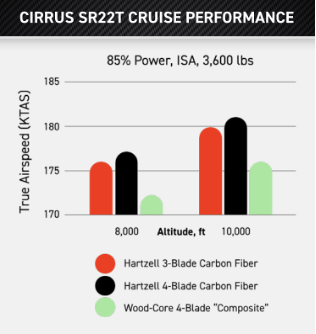
It’s just one example of the aerodynamic design and engineering expertise behind Hartzell’s purpose-built propeller systems.
3. How will the propeller affect long-term ownership costs?
The propeller on your airplane does more than influence performance and ramp appeal. It plays an important role in your aircraft’s ongoing maintenance needs and lifetime cost of ownership.
Consider these factors:
- Blade Life: Hartzell carbon fiber blades are certified for unlimited life, with some blades exceeding 50,000 hours in service. How is this possible? Because our carbon fiber blades are designed to be restored over and over again. When small nicks, cracks, or stone damage occur, carbon material can be added back during repair, preserving proper geometry and extending the blade’s service life indefinitely.
- Durability: Hartzell blades feature nickel leading edges for superior erosion resistance, along with a nickel erosion mesh beneath the paint for added protection against stone chips and debris. The leading edges are replaceable, so you can fly with confidence in gravel, backcountry, and high-cycle operations.
- Ease of Repair: Most minor repairs can be performed “on-wing”, meaning the propeller can remain installed on the aircraft rather than being removed and shipped to a prop shop. For certified aircraft, approved repairs can be completed by an A&P mechanic, helping reduce downtime and maintenance costs. For Experimental aircraft, repairs may be completed by the builder/owner in accordance with applicable regulations.
Only Hartzell carbon fiber blades offer exceptional durability, real-world serviceability, and long-term value for the life of your aircraft. Why compromise?
Experience the Hartzell Advantage
If you want to get the most out of your investment, it’s worth equipping your new aircraft with the most advanced propeller technology on the market.
Before you buy, make sure your propeller is Built On Honor. Ask your sales rep for a Hartzell by name.
Ready to explore carbon fiber propeller options? We’re here to help.
If you want to level up your current airplane propeller, Hartzell’s Top Prop STC program makes it easy to upgrade from a legacy prop to one of our advanced carbon fiber props.
You can even reduce your Top Prop purchase price by trading in your existing, serviceable propeller* of any general aviation aircraft make and model.
Contact us to learn more about current offers and eligibility. We’re here to answer your questions and guide you through the process of finding the best propeller for your aircraft.
*Trade-in purchases are at the discretion of Hartzell Propeller, Inc. All core purchases require (a) complete logbook information detailing maintenance history, (b) applicable 8130-3 certificates, and (c) a recorded Time Since New (TSN).